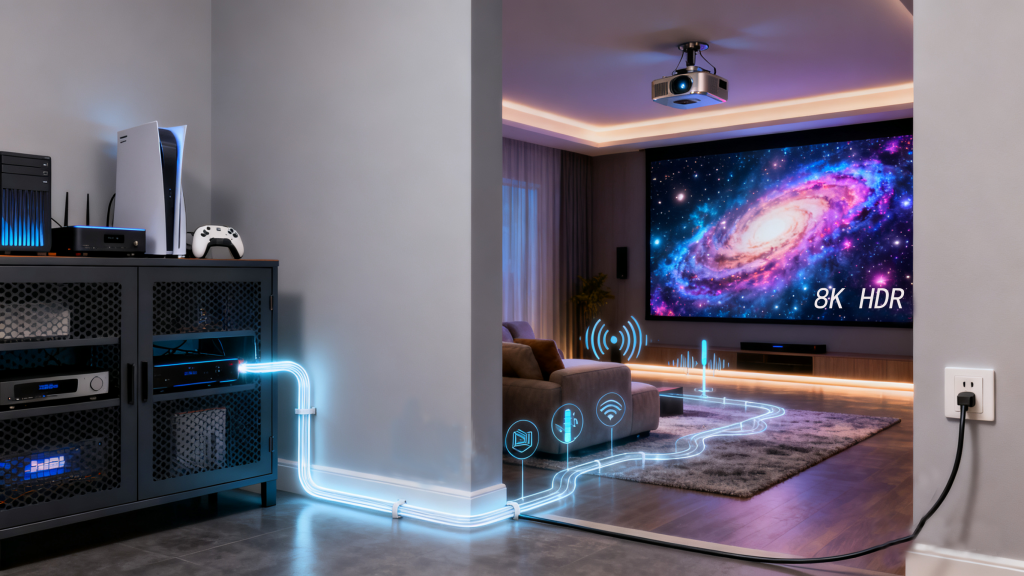
As 4K/8K and high-refresh-rate gaming become the norm, traditional HDMI copper cables are prone to signal attenuation and interference over long-distance transmission. HDMI optical cables have emerged as the ideal solution to address this pain point.
- Core Principle: Light Transmits Shadows
The HDMI optical fiber cable has built-in photoelectric conversion chips at both ends:
Transmitting end: Convert the electrical signals output by the device into optical signals.
Fiber optics: Light signals propagate through the core at the speed of light, with no loss or interference.
Receiver: Convert the optical signal back into an electrical signal and feed it to the display device.
- Highlighting Advantages
Long-range lossless: Easily achieve ultra-long-distance transmission beyond 50 meters with no loss in picture or sound quality.
Fine and lightweight: The wire is slender and flexible, making it easy to thread, embed, and organize.
Strong anti-interference: Completely immune to electromagnetic interference, with pure and stable signals.
Ample bandwidth: Supports the HDMI 2.1 standard, perfectly compatible with 8K, HDR, and high refresh rate requirements.
III. Main Application Scenarios
Home Theater: The Best Choice for Projectors to Connect to Playback Devices Over Long Distances.
Commercial Display: Stable signal transmission over long distances and across multiple screens in museums, shopping malls, and other venues.
High-end esports: Lossless transmission of 4K@120Hz visuals, ensuring an ultra-smooth experience.
Professional Fields: Environments with extremely high requirements for signal stability, such as medical and industrial control.